Marilyn Manson Portrait of an American Family Shirt
| Portrait of an American Family | ||||
|---|---|---|---|---|
 | ||||
| Studio anthology by Marilyn Manson | ||||
| Released | July 19, 1994 (1994-07-19) | |||
| Recorded | Baronial–December 1993 | |||
| Studio |
| |||
| Genre |
| |||
| Length | 60:52 | |||
| Label |
| |||
| Producer |
| |||
| Marilyn Manson chronology | ||||
| ||||
| Singles from Portrait of an American Family | ||||
| ||||
Portrait of an American Family is the debut studio anthology by American stone band Marilyn Manson. It was released on July 19, 1994 by Nothing and Interscope Records. The group was formed in 1989 by vocalist Marilyn Manson and guitarist Daisy Berkowitz, whose names were created by combining the given name of a popular culture icon with the surname of a serial killer: a naming convention which all other band members would conform to for the next seven years. The about prominent lineup of musicians during their formative years included keyboardist Madonna Wayne Gacy, bassist Gidget Gein and drummer Sara Lee Lucas.
The band's highly visualized concerts earned them a loyal fanbase in the South Florida punk and hardcore music scene, somewhen gaining the attention of Nine Inch Nails singer Trent Reznor, who signed them to his Nothing Records vanity characterization. The album was initially produced past Roli Mosimann at Criteria Studios in Miami under the title The Manson Family unit Anthology. However, the band was unhappy with his production, and this material was then re-produced and remixed in diverse Los Angeles recording studios by Manson and Reznor, forth with assistant producers Sean Beavan and Alan Moulder. Parts of the anthology were re-recorded at Reznor's home studio at 10050 Cielo Drive, where members of the Manson Family infamously committed the Tate murders in 1969.
Gidget Gein was not invited to the Fifty.A. recording sessions. He had been fired from the band in late 1993 due to his ongoing habit to heroin, and was replaced by Twiggy Ramirez. Despite this, Gein is credited with performing the entirety of the bass work on the album, while the majority of Sara Lee Lucas' alive drumming was replaced with electronic drum programming from 9 Inch Nails keyboardist Charlie Clouser. The record contains a broad array of cultural references; Interscope delayed its release on several occasions due to the inclusion of references to Charles Manson, and also because of objections to its controversial artwork.
Portrait of an American Family was released to express commercial success and more often than not positive reviews; in 2017, Rolling Stone accounted the album i of the greatest in the history of heavy metal music. The grouping embarked on several concert tours to promote the release, including appearing equally an opening deed on Nine Inch Nails' "Cocky Destruct Bout", as well equally the "Portrait of an American Family Bout". "Get Your Gunn" and "Lunchbox" were issued every bit commercial singles, while "Dope Hat" was released as a promotional unmarried. The record was certified gold by the Recording Industry Association of America in 2003 for shipments of over 500,000 units in the United states of america.
Background [edit]
Marilyn Manson and the Spooky Kids was formed in December 1989 when vocalist Marilyn Manson met guitarist Daisy Berkowitz at the Reunion Room,[3] a pocket-size nightclub in Fort Lauderdale, Florida.[four] The 2 were writing original compositions past the first of 1990, with Manson the sole lyricist and Berkowitz composing the majority of music.[three] Until 1996, the names of band members were derived from combining the beginning name of a pop culture icon with the surname of a series killer.[v] The earliest incarnation of the band also included Olivia Newton Bundy on bass guitar,[six] and Zsa Zsa Speck on keyboards, along with an electronic drum machine.[vii] Speck was hired by the ring on a temporary basis equally their original choice for keyboardist, Madonna Wayne Gacy, was unable to obtain a keyboard.[7] The original lineup was retained for two performances, the showtime of which took place at Churchill's Hideaway in Miami, with 20 audience members in attendance.[viii] As Gacy could nonetheless non afford to purchase an instrument, he appeared on-stage at their second evidence – at the Reunion Room – playing with toy soldiers.[8] Speck and Bundy both exited the group old after this performance.[nine]

The band's highly visualized concerts primarily drew from elements of shock art.[10] Their live shows routinely featured naked women nailed to crucifixes, young children locked in cages,[eleven] amateur pyrotechnics and sadomasochism,[10] equally well as piñatas filled with butchered animal remains and experiments in contrary psychology.[N i] These concerts speedily earned them a loyal fanbase amongst the South Florida punk and hardcore music scene, and were playing sold-out shows in 300-capacity nightclubs throughout Florida inside six months of forming.[4] In Feb 1990, while working as a journalist at 25th Parallel, Manson interviewed Trent Reznor of Ix Inch Nails.[4] The pair remained friends afterwards, and Reznor was somewhen presented with a compilation of the band's demo recordings.[12] Afterwards being impressed by the material, Reznor offered the grouping a spot opening for Nine Inch Nails and Meat Trounce Manifesto at Club Nu in Miami on July 3, 1990.[4]
In early 1991, the group signed a record deal with Sony Music. Yet, Berkowitz afterward recalled that the president of A&R at the label, Richard Griffin, "personally rejected u.s.a. inside minutes, maxim he liked the show and the idea but 'didn't like the singer'". They used the proceeds of the bargain to fund the recording of subsequent demo tapes.[13] Bassist Gidget Gein and alive drummer Sara Lee Lucas would eventually join the band, and they continued touring and releasing EPs independently for the side by side two years.[11] In November 1992, Reznor invited the band's vocalist to attend "strategic talks" in Los Angeles,[4] and to appear as a guitarist in a music video for the 9 Inch Nails track "Gave Upwardly".[14] By the end of the year, Marilyn Manson and the Chilling Kids were the first human activity signed by Reznor's vanity characterization, Nothing Records,[15] shortening their proper noun to Marilyn Manson in the commencement of 1993.[16]
Recording [edit]
"When nosotros were finally finished, Roli had done the opposite of what I'd expected. I thought he was going to bring out some sort of darker chemical element. Only he was trying to polish all the crude edges and make us more of a rock band, a pop ring, which at the time I wasn't interested in at all. I idea the record nosotros did with him came out bland and lifeless. Trent thought the same thing so he volunteered to help united states of america repair what had been damaged."
—Marilyn Manson discussing the aftermath of the album's initial recording sessions.[17]
Marilyn Manson held recording sessions for their debut anthology, so titled The Manson Family Album, in July 1993 at Criteria Studios in Miami with producer Roli Mosimann.[xviii] The album consisted of re-recorded versions of songs originally demoed by the group during their formative years.[11] According to Loudwire, Mosimann'due south original production aimed for a "sleazy, groove-laden" audio.[18] Sessions ended several months afterwards in the fall.[xix] At this point, Mosimann created a radio edit of "Ophidian Eyes and Sissies", indicating that this song was intended to be released as the lead unmarried.[20] Yet, the band was unhappy with Mosimann's production, challenge it to exist unrepresentative of their live performances,[17] while Manson claimed the songs sounded too polished, saying: "I idea, 'This actually sucks.' So I played information technology for Trent, and he thought it sucked."[11]
Before reworking the album in Los Angeles, the band played shows in Florida nether the name Mrs. Scabtree,[21] which consisted of members of Marilyn Manson, Amboog-a-Lard, Jack Off Jill and The Crawling. Manson had produced various releases by both of the latter bands in 1993.[22] The band and then travelled to the Record Plant in L.A. to remix The Manson Family Album over a seven-week period with Reznor,[18] with Manson explaining: "We spent seven weeks redoing, fixing, sometimes starting from scratch. That was our ring'southward first experience in a real studio on a project this big. We didn't know what to expect. It was fifteen-hour days, with a squad – Trent, Alan Moulder, Sean Beavan, and me – bringing out the sound."[11] Berkowitz was initially reluctant to re-record the anthology, maxim: "I felt doing this was unnecessary, and worried it would make us look like a Nine Inch Nails/Reznor spin-off. The concluding result, all the same, is a very loftier-quality piece of work."[23]
Berkowitz re-recorded some of his guitar work in L.A., and the vast majority of Sara Lee Lucas' live drumming was replaced with drum programming created by 9 Inch Nails keyboardist Charlie Clouser.[18] Gidget Gein was not invited to these sessions.[eighteen] He had been fired from the ring a few days before Christmas 1993 due to his heroin addiction. Berkowitz clarified that this was "the second or 3rd time [he was being fired], for being a junkie and not showing upward. And playing really horribly alive."[4] He was replaced by Jeordie White of Amboog-a-Lard, who was renamed Twiggy Ramirez.[11] Despite this, Gein is credited with performing the entirety of the bass work on the album,[11] with Ramirez credited for "base tendencies".[24] Gein afterward died of a heroin overdose in 2008.[25] Post-obit this menstruum of re-recording, The Manson Family Album was retitled to Portrait of an American Family unit.[18] Mosimann was listed in the liner notes as an engineer, with no mention of his original product role.[24]
Sections of the anthology were recorded and mixed at 10050 Cielo Drive: the address of the house where members of the Manson Family committed the Tate murders in 1969.[26] Reznor rented the property in 1992 and built a recording studio inside the residence, which he named 'Grunter'—a reference to that word being written with Sharon Tate's blood on the front end door of the house on the night of the massacre.[27] [28] The studio is credited as 'Le Sus scrofa' in the anthology's liner notes.[24] Reznor denied renting the holding in an attempt to take the infamy of the massacre associated with his music, and chastised Manson for doing so, maxim: "I wasn't trying to create some manufactured spooky thing. Whatever stupor value to what I was doing was nearly trying to sneak subversive things to a wide audience. With [Manson] ... he knew exactly what he was doing and exactly what would be shocking. Those were very conscious decisions on his role. What I was doing wasn't the same thing."[29] The house was demolished in late 1994,[xxx] with Reznor transporting the original "Pig" door to New Orleans, where it was installed equally the entrance to his subsequent recording studio, Nothing Studios.[31]
Composition and style [edit]

The record contains a broad array of cultural references,[24] beginning with the beginning track: the poem recited in "Prelude (The Family Trip)" is an adaption of a poem originally from the 1964 novel Charlie and the Chocolate Factory, which later appeared during the tunnel boat ride scene from Willy Wonka & the Chocolate Factory.[32] [33] In his autobiography, The Long Hard Route Out of Hell, Manson explained that the lyrics to the second song on the album, "Cake and Sodomy", were inspired past a trip to New York City in 1990. He said that he wrote its lyrics in a hotel room later spending several hours viewing public-access cable television and "watching Pat Robertson preach about society's evils and and so inquire people to phone call him with their credit card number. On the adjacent channel, a guy was greasing up his erect with Vaseline and asking people to call and give him their credit carte number."[34] The song's intro contains several samples, including Marlon Brando in the 1972 film Last Tango in Paris saying "Proceed and smile, you cunt!", and Mink Stole's graphic symbol from John Waters' 1977 motion picture Desperate Living repeatedly screaming "White trash!".[24]
"Lunchbox" was inspired by a 1972 law introduced by the Florida Legislature, which made information technology illegal to deport a metal lunch-box on schoolhouse grounds.[35] It tells the story of a bullied kid who uses a dejeuner-box equally a defensive weapon, and proclaims that one day he will be a "large rock 'due north' ringlet star".[36] The track incorporates elements from The Crazy World of Arthur Brownish's 1968 single "Fire".[24] "Organ Grinder" makes use of diverse dialogue excerpts of the Child Catcher from the 1968 picture Chitty Chitty Blindside Bang, while "Cyclops" contains a distorted sample of the preacher from Poltergeist 2: The Other Side (1986).[24] [37] "Dope Hat" contains various samples of dialogue spoken by Charles Nelson Reilly – the actor who portrayed Horatio J. HooDoo – in Sid and Marty Krofft'due south tv series Lidsville (1971–73).[24] The lyrics to "Get Your Gunn" were inspired past the murder of Dr. David Gunn, who was killed past a cocky-proclaimed pro-life activist.[18] Manson later described his murder equally "the ultimate hypocrisy I witnessed growing upwards: that these people killed someone in the proper name of being 'pro-life'."[38] The song as well features audio from the televised suicide of Pennsylvania Treasurer R. Budd Dwyer.[2] [39] [40]
"We were using a computer considering we had a lot of samples and sequencing. While nosotros were working on that vocal the Charles Manson samples from 'My Monkey' started appearing in the mix. All of a sudden we'd hear, 'Why are the children doing what they're doing? Why does a child reach up and impale his mom and dad and murder his two little sisters so cut his throat?' And we couldn't figure what was going on. The chorus of 'Wrapped in Plastic' is, 'Come into our home/Won't you stay?' And we're in the Sharon Tate house, but me and Sean Beavan. We got scared and were like, 'We are done for the nighttime.' We came back the side by side mean solar day and information technology was fine. The Charles Manson samples weren't even on the tape anymore. There's no real logical or technological explanation for why they appeared. Information technology was a truly supernatural moment that freaked me out."
—Marilyn Manson discussing paranormal activity during the mixing of "Wrapped in Plastic".[41]
The title of "Wrapped in Plastic" is a reference to David Lynch's television series Twin Peaks, specifically the scene in the pilot episode where Laura Palmer's expressionless body is discovered wrapped in sheets of plastic.[xviii] "Dogma" contains a sample of dialogue from John Waters' 1972 film Pink Flamingos. Although the clips from Desperate Living on "Block and Sodomy" and "Misery Machine" are credited in the liner notes, this prune is not; Waters is additionally thanked in the album credits.[24] "Sweet Tooth" is the but vocal on the record for which former bassist Gidget Gein wrote both guitar and bass parts.[24]
A line of dialogue spoken at the offset of "Snake Eyes and Sissies" – "Killing is killing whether done for duty, profit or fun" – is a quote taken from an interview with series killer Richard Ramirez.[42] "My Monkey" contains numerous samples of interviews from Charles Manson;[43] several of its verses are derived from "Mechanical Human", a vocal from his 1970 album Lie: The Love and Terror Cult.[44] Its lyrics are credited simply to "Manson".[24] The vocal besides contains vocals from Robert Pierce, who was half-dozen years old at the time of its recording.[45] He was the son of Rambler guitarist Richard Pierce, and was introduced to Marilyn Manson when both bands shared a rehearsal space in Florida.[46]
"Misery Automobile" is the thirteenth and last track on the anthology, and contains a sample from "Beep Beep" by The Playmates.[24] The championship is a direct reference to the Mystery Machine from the animated boob tube series Scooby-Doo,[18] while a phrase contained in the vocal, "We're gonna ride to the Abbey of Thelema", is a reference to Aleister Crowley's spiritual philosophy of Thelema: "Do what thou wilt shall be the whole of the Law. Honey is the law, honey under volition."[47] An untitled hidden track begins a few seconds subsequently "Misery Motorcar", and consists of Stole in Desperate Living screaming "Become domicile to your mother! Doesn't she always watch you lot!? Tell her this isn't some Communist daycare centre! Tell your female parent I hate her! Tell your mother I hate you!". After this, a telephone rings for several minutes, followed by an irate answering auto message from the mother of a Manson fan.[24]
The ring's vocalist discussed his thoughts on Portrait of an American Family unit in retrospect with Empyrean Magazine, circa May/June 1995:
Well, the whole betoken of the album was that I wanted to say a lot of the things I've said in interviews. Only now I feel like I savage brusk, similar I didn't say it right. Maybe I was too vague, or maybe the songs weren't good plenty, or any. Only I wanted to address the hypocrisy of talk show America, how morals are worn as a bluecoat to make you look good and how it'due south so much easier to talk about your behavior than to live up to them. I was very much wrapped upwardly in the concept that every bit kids growing up, a lot of the things that we're presented with have deeper meanings than our parents would like us to see, like Willy Wonka and the Brothers Grimm. And then what I was trying to point out was that when our parents hide the truth from united states, it's more dissentious than if they were to betrayal us to things like Marilyn Manson in the get-go place. My signal was that in this fashion I'thousand an anti-hero. I retrieve I'll exist able to say information technology better on the side by side album."[48]
Comprehend and packaging [edit]
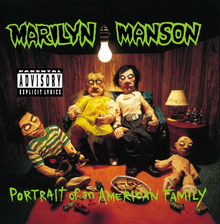
The four-fellow member family depicted on the album cover were created past Manson using papier-mâché and human hair.[11] In The Long Hard Road Out of Hell, the vocaliser said that a painting past John Wayne Gacy was originally set to feature as the embrace; the same painting after appeared on the cover of Acid Bathroom'due south 1994 anthology When the Kite String Pops.[49] Likewise set to announced equally part of the album's interior artwork was an prototype of himself as a child sitting naked on a living room couch.[fifteen] Although the photograph was taken by his mother with no vulgar intent, and no ballocks is shown, Interscope's parent company Fourth dimension Warner demanded it be removed on the grounds that it could constitute kid pornography.[N ii] Manson explained the groundwork of the image: "When I was six years old, that was when Burt Reynolds had posed for Playgirl. My mom thought it'd exist funny to have me do that pose, lying on a couch. It's only sick if you accept a sick listen. It was innocent."[11] Some other piece of interior photography consisted of an image of a Blythe doll surrounded past Polaroid pictures of a mutilated female person body, purportedly faked by Manson and several of his friends.[49]
Release and promotion [edit]
When the tape was presented to Nothing'due south parent company Interscope in January 1994, executives at the label refused to release it unless all references to Charles Manson were removed. This included altering the band's proper name, and omitting the song "My Monkey".[N 3] The singer explained: "I think the Axl Rose/Charles Manson thing panicked them. The heat came from the name of our band. They evidently hadn't looked into it very carefully, and they had this knee-jerk reaction to what we're about."[eleven] Guns N' Roses had faced widespread criticism over the inclusion of "Look at Your Game, Girl" – a encompass of a Charles Manson song – as a hidden track on their 1993 album "The Spaghetti Incident?".[50]
During this period, the band's management attempted to have it issued through other labels and distributors.[xi] They met with Guy Oseary and Freddy DeMann from Maverick Records, Madonna's vanity label, who were initially worried that their lyrics or epitome included antisemitism,[N 4] although they found this was non the example. Afterwards, Maverick offered the band an alternate deal.[52] Before this deal could be finalized, Interscope agreed to release the anthology,[11] which was issued in the United States on July 19, 1994.[xviii] The Honolulu Star-Bulletin reported that Members of the British Parliament tried to ban the album in the United kingdom of great britain and northern ireland and chosen it an "outrage against society."[53] Portrait of an American Family was preceded by the release of "Get Your Gunn" as the lead single on June nine.[54] Its music video was directed by Rod Chong.[55]

Marilyn Manson performed as one of the opening acts on Nine Inch Nails' "Self Destruct Tour" throughout 1994.[29] They embarked on their start national headlining tour in December,[56] with Monster Voodoo Machine and Arab on Radar supporting.[57] The tour would be problematic, still. The band'due south vocalist was arrested after the tour's offset date, in Jacksonville, for allegedly violating Florida's Developed Entertainment Code past simulating sex on stage while wearing a strap-on dildo.[26] He narrowly avoided arrest 4 nights subsequently – on New year's Eve in Fort Lauderdale – after 9 Inch Nails guitarist Robin Finck jumped on phase wearing a g-string and attempted to play an unspecified applied joke on the singer involving powdered carbohydrate. Manson reacted by tearing the thou-string off and placing Finck'south penis in his mouth. He hid from local constabulary in a backstage bath.[N v]
This would as well be drummer Sara Lee Lucas' terminal tour with the band. Tensions developed between him and Manson as the tour progressed and, during the second-to-last testify, Manson doused Lucas' drum kit in lighter fluid and set it ablaze.[59] He was immediately replaced by Kenneth Wilson, who joined the group as Ginger Fish.[N six] The "Lunchbox" EP was released on Feb 6, 1995, containing several remixes of the song created past Charlie Clouser too as a cover of Gary Numan's "Downwardly in the Park".[61] Richard Kern directed the music video for the rail.[55] Marilyn Manson toured again in the spring of 1995, opening for Danzig alongside Korn.[62] [63]
"Dope Lid" was issued every bit a promotional single in the summer of 1995.[64] Its music video was directed by Tom Stern,[65] and was based on the tunnel boat ride scene from Willy Wonka.[66] The band entered Reznor's Cipher Studios in New Orleans to record b-sides for the vocal'due south release every bit a commercial single. All the same, the release was cancelled, as the textile recorded during these sessions was compiled into a standalone EP of embrace versions, remixes and interludes titled Smells Like Children.[64] Portrait of an American Family was re-released in 2009 as a limited edition green-colored vinyl LP box set, which also independent a T-shirt emblazoned with the anthology cover.[67]
Critical reception and legacy [edit]
| Review scores | |
|---|---|
| Source | Rating |
| AllMusic |    [68] [68] |
| Rolling Rock | [69] |
The anthology received more often than not positive reviews. Stephen Thomas Erlewine of AllMusic said that "Below all the campsite stupor, there are signs of [Manson's] unerring heart for genuine outrage and musical talent, peculiarly on the trio of 'Cake and Sodomy', 'Lunchbox', and 'Dope Chapeau'."[seventy] Rolling Rock was negative, maxim that the anthology was not the "sharply rendered cultural critique of America [Manson would] similar you to think it is. Most of the record comes off like some low-budget horror movie."[69] The publication subsequently revised its view of the tape; information technology was included at number 68 on their 2017 list of The 100 Greatest Metal Albums of All Time.[71] Guitar Globe ranked the album at number 13 in their list of the 50 Iconic Albums That Defined 1994,[72] although they besides featured "Cyclops" at number 47 on their list of the 100 Worst Guitar Solos.[73] Manson himself has been dismissive of the album, ranking it in terminal identify of the band's unabridged discography in a 2018 list compiled for Kerrang!.[74] Conversely, Kristy Loye of the Houston Printing dubbed it the best anthology of the band's career, writing: "This album's impact on music at the fourth dimension of release cannot actually exist underestimated, nor can it be accurately described in a brusk blurb. Like it or non, Marilyn Manson and the Spooky Kids gave rock the nighttime shot in the arm that was needed at the fourth dimension when music had given itself completely over to the bland and self-indulgent emotional ballads of alt-rock kings similar Pearl Jam. Music needed a balance of dark and light and Manson brought the darkness like few were doing at the time when of a sudden metallic was barely breathing."[75]
In a feature written for the twentieth anniversary of the record, Tom Breihan of Stereogum praised the album'due south production and quality of the band'southward songwriting, but said that Portrait of an American Family unit had anile badly, and was disquisitional of Manson'southward vocals and the amount of samples used throughout. However, he went on to argue: "What still resonates about Manson isn't really his music, though 1998's Mechanical Animals still stands as a pretty incredible album. Manson was a culture-war anarchist for our side: someone willing to jar and frighten the fuck out of the power structures that seemed in that location to continue teenagers in their identify. His whole matter was a violent, overblown rejection of vast forces of oppression and command, and his tactics made him a target, both of mass-civilisation disdain and of superior alt-civilisation snark. All that was past pattern. He put himself out there to take those attacks. And, on some level, he's a saint for that. Simply past existing, and by moving the baseline, he made lives easier for hundreds of thousands of teenagers. That, rather than 'Block and Sodomy', is his legacy."[32]
Commercial operation [edit]
Portrait of an American Family failed to chart upon release. Manson later on complained: "Well, at that place was always a real chip on our shoulder that the album never actually got the button from the record label that we thought information technology deserved. Information technology was all about us touring our fucking asses off. We toured for two years solid, opening upward for Ix Inch Nails for a year and then doing our own club tours. It was all just virtually perseverance."[76] It eventually peaked at number 35 on Billboard 'southward Pinnacle Heatseekers nautical chart, on the issue dated March 25, 1995.[77] The record was certified gilt by the Recording Manufacture Association of America in May 2003 for shipments in excess of 500,000 units.[78] As of 2015, it has sold over 645,000 copies in the United States.[79] Despite never entering the height 100 of the UK Albums Chart,[fourscore] in 2013 the record was certified silverish by the British Phonographic Industry, indicating sales[81] in backlog of 60,000 copies in that country.[82]
Rail listing [edit]
All lyrics written by Marilyn Manson, except track ane by Manson and Roald Dahl,[24] and runway 12 by Marilyn Manson and Charles Manson (uncredited).[7]
| No. | Title | Music | Length |
|---|---|---|---|
| 1. | "Prelude (The Family Trip)" |
| 1:20 |
| 2. | "Block and Sodomy" | Daisy Berkowitz | 3:46 |
| iii. | "Lunchbox" |
| 4:32 |
| 4. | "Organ Grinder" |
| 4:22 |
| five. | "Cyclops" |
| three:32 |
| 6. | "Dope Hat" |
| 4:18 |
| 7. | "Become Your Gunn" |
| 3:18 |
| 8. | "Wrapped in Plastic" | Berkowitz | 5:35 |
| 9. | "Dogma" | Berkowitz | 3:22 |
| ten. | "Sweet Molar" |
| 5:03 |
| 11. | "Serpent Eyes and Sissies" |
| 4:07 |
| 12. | "My Monkey" | Berkowitz | 4:29 |
| 13. | "Misery Machine" ("Misery Auto" ends at 5:09, an excerpt from "Desperate Living" is played until 5:28. Telephone ringing is heard for seven:10, until an answering machine bulletin from an irate mother is heard at 12:38.) |
| 13:08 |
| Total length: | sixty:52 | ||
| No. | Title | Writer(s) | Length |
|---|---|---|---|
| 14. | "Down in the Park" | Gary Numan | 5:00 |
| 15. | "Brown Bag" (Remix of "Lunchbox" by Charlie Clouser) |
| 6:19 |
| Full length: | 72:11 | ||
Sample credits [24] [37]
- "Prelude (The Family Trip)" contains an adaption of "The Rowing Song" past Roald Dahl.
- "Lunchbox" contains a vocal sample from "Fire" by The Crazy Globe of Arthur Brownish.
- "My Monkey" contains an adaption of "Mechanical Homo" by Charles Manson.
- "Misery Machine" contains an interpolation of "Beep Beep" by The Playmates.
- The tape additionally features excerpts of dialogue from Last Tango in Paris, Desperate Living, Chitty Chitty Bang Bang, Poltergeist Ii: The Other Side, Lidsville, Twin Peaks and Pink Flamingos.
Personnel [edit]
Credits adapted from AllMusic,[84] and the liner notes of Portrait of an American Family.[24]
Marilyn Manson
- Marilyn Manson – vocals, brass, loops, production, lyrical adaption, musical composition, artwork, logo (credited every bit "accusations, kid manipulations, backwards masking, polaroids, doll family, album design")
- Daisy Berkowitz – lead, rhythm, acoustic and wah-wah guitars, musical limerick (credited as "psychoacoustical guitars")
- Gidget Gein – bass and musical limerick
- Madonna Wayne Gacy – keyboards, calliope, Hammond organ, theremin, saxophone, audio effects, loops, musical composition (credited as "Hammond organ, theremin, saxophone, calliopenis, contumely, babies, distorted muzette, loops, Maria, the sorry pot pie brass department")
- Sara Lee Lucas – drums and audio effects (credited every bit "hitting")
Production, technical and additional personnel
- Tom Baker – mastering (at Future Disc, Los Angeles)
- Sean Beavan – brass (track 12), digital sound editing, programming, technology, banana producer, mixing
- Frank Callari – bout manager (for TCO Group)
- Charlie Clouser – drums (track viii), African drums, drum programming, digital sound editing
- Donovan – "tattoos"
- Marking Freegard – mixing
- Barry Goldberg – assistant engineer
- Marc Gruber – banana engineer
- Roli Mosimann – engineering science and original production
- Alan Moulder – engineering, assistant producer, mixing
- Chris Meyer – alive sound
- Hope Nicholls – saxophone (track 7), groundwork vocals (runway nine)
- Robin Perine – photography
- Robert Pierce (aged 6) – vocals (tracks 3 and 12)
- Brian Pollack – banana engineer
- Twiggy Ramirez – live bass for the "Portrait of an American Family unit Tour" (credited as "base tendencies")
- Trent Reznor – "bionic" guitar (track three), brass (track 12), digital sound editing, programming, production, executive producer, mixing
- Melissa Romero (aged 19) – 'violation' on "Wrapped in Plastic"
- Brian Scheuble – banana engineer
- Albert Sgambati – "tattoos"
- Gary Talpas – packaging
- John Tovar – management (for TCO Grouping)
- Chris Vrenna (credited as "Podboy") – percussion (rails 6; credited as "skull" on track 10), programming, assistant engineer
- Jeff Weiss – anthology cover image and additional photography
- Wade Wright – "mood lighting"
- Sioux Z. – publicity (for Formula)
Charts [edit]
Certifications [edit]
References [edit]
Notes
- ^ "In an endeavor to reiterate the lesson of Willy Wonka in my ain manner during shows, I hung a donkey piñata over the crowd and put a stick on the edge of the stage. And so I would warn, 'Delight, don't interruption that open. I beg you not to.' Human psychology existence what it is, kids in the crowd would invariably grab the stick and smash the piñata apart, forcing everyone to endure the outcome, which would exist a shower of cow brains, chicken livers and pig intestines from [the] disemboweled donkey."[x]
- ^ "I wanted to use a photo in the booklet of me naked on a couch when I was a kid. When yous hold upwards something to people, usually what they run across in information technology is what'southward inside them in the first identify. And that'south what happened because the lawyers at Interscope said, 'Get-go off, that flick'south going to be considered child pornography, and not merely will no stores carry the album but we're discipline to legal retribution from it.' They said if a judge were to look at it, the law states that if a photograph of a minor elicits sexual excitement then it's considered child pornography. I said, 'That'southward exactly my point. This is a photograph that was taken by my mother, and it'due south extremely innocent and very normal. Only if you see it equally sexual, then why am I the guilty person? You're the i who's got a difficult-on. Why aren't you punished?' That'due south withal a point I'd like to make."[49]
- ^ "[Later on "The Spaghetti Incident?" was released, Axl Rose] started getting all that heat from Sharon Tate'southward sister and everyone. When our album was finished after that, we had the vocal 'My Monkey' on it but we had this 6-yr-old kid Robert Pierce singing the Charles Manson lyrics. That was the groovy irony of information technology: hither'southward a kid that'southward singing a vocal that to him is an innocuous nursery rhyme but to everyone else is this horrible affair. After we turned the anthology in, I got this call from Trent and John Malm, who's Trent'south director and runs Nothing Records. And they're like 'Are you willing to put out your anthology without 'My Monkey' on it?' I asked, 'Why?!' And they said, 'Well, Interscope is having problems because of the shit that Axl Rose has gotten himself into. He'southward had to donate the gain of the vocal to the victims' families.' I said, 'Well I don't accept a problem doing that. Merely explicate to me what's going to happen.' (The unabridged vocal wasn't Charles Manson's song. I only borrowed a few lyrics and the residual were my own.) In the end, Interscope insisted that nosotros take the song off. I said 'No', so they told united states they weren't going to put the album out at all."[45]
- ^ "While everything was in the air, Trent backed us up and stood behind u.s.a.. He told us not to worry considering he had an selection to put out a record with whatsoever other characterization as part of his contract with Interscope, fifty-fifty though it technically endemic Nothing. So we had Guy Oseary from Maverick Records down to see u.s. and he brought Freddy DeMann, Madonna's director. The funniest thing well-nigh those guys was the first thing they said to me after the show was 'Are you lot guys Jewish?' And our keyboard player said, 'Yes, I'thou Jewish, merely I'k not religious. I don't practise information technology.' And they said 'Yep, okay, that'south cool. We gotta stick together.' We had this whole bonding thing. Then they went back to New York and our director got a call two days later on. They asked, 'We don't really have a trouble with Manson'due south paradigm, the tattoos, the association with the occult and Satanism. But there's something we need to know: Does Manson have whatever swastikas tattooed on him?' And he's like, 'No. What are y'all talking about?' They said, 'Well, we but wanted to check because if there's any sort of antisemitic message and then information technology'south non something nosotros desire to exist involved in.' Everything I was doing was so much about sticking up for the underdog that I couldn't understand how they could misassociate what I was doing like that. It was weird. Later my tattoos checked out, they actually offered u.s. a deal. It must have lit a fire under Interscope's ass because all all of a sudden Interscope came back and told us they were willing to put out the tape and fifty-fifty pay for it. We agreed because we had e'er wanted Interscope from the beginning. I had faith in that characterization. I still practise. They had a bargain with Time Warner, who were the ones causing the bug."[51]
- ^ "But what happened was while nosotros were performing, Robin [Finck], the guitarist in Nine Inch Nails, ran out on phase in a one thousand-string with some kind of powdered confectionery detail he planned to dump on me for whatever reason. In the midst of this sabotage endeavor, I grabbed him and tore his g-string off and placed his limp, salty penis in my mouth and, um, teethed on it for a moment, just not long enough to actually plant a blow-job. ...I didn't have a hard-on, which should relieve me of any accusations of it beingness a degenerate homosexual act. Later on, he ran off phase sort of embarrassed and I had to flee from the cops when the show ended. They came backstage looking for me, and I hid in the bathroom where, conveniently, some drugs had been stashed. Luckily, they never issued a warrant for my arrest or prosecuted me for that particular incident."[58]
- ^ "Everybody knew that Freddy was going to exist fired except for Freddy considering just a week earlier, while he was polishing his spokes or something, nosotros auditioned a serenity, older drummer from Las Vegas named Kenneth Wilson and asked him to join the band every bit Ginger Fish. He actually rode the tour bus with usa i night and we told Freddy that he was only a friend of our tour manager. He bought information technology. We didn't want to exist roughshod to Freddy because we liked him every bit a person. We just felt obliged to make his last show with the band a memorable one. ... We sacrificed Freddy past setting his bass drum on fire, but the whole drum kit burst into flames, followed by Freddy. Every bit Freddy escapes backstage to find a fire extinguisher we started smashing everything."[60]
References
- ^ "Marilyn Manson Biography". Rolling Stone. Archived from the original on Baronial 29, 2016. Retrieved Baronial 12, 2017.
- ^ a b Schafer, Joseph (April 8, 2015). "The ten Best Marilyn Manson Songs". Stereogum. Archived from the original on July 9, 2017. Retrieved May thirty, 2018.
- ^ a b Tron, Gina (April 10, 2014). "Daisy Berkowitz: Portrait of an American Ex-Marilyn Manson Member". Vice. Archived from the original on April 2, 2016. Retrieved September 27, 2017.
- ^ a b c d e f Stratton, Jeff (April 15, 2004). "Manson Family Feud". New Times Broward-Palm Beach. Voice Media Group. Archived from the original on October 9, 2016. Retrieved September 27, 2017.
- ^ Wartofsky, Alona (May ix, 1997). "Manson Family Values". The Washington Post. Archived from the original on June 26, 2018. Retrieved June 25, 2018.
- ^ Manson & Strauss 1998, p. 84
- ^ a b c Manson & Strauss 1998, p. 87
- ^ a b Manson & Strauss 1998, p. ninety
- ^ Manson & Strauss 1998, p. 91
- ^ a b c Manson & Strauss 1998, pp. 93–94, 116
- ^ a b c d e f g h i j thou fifty Baker, Greg (July 20, 1994). "Manson Family Values". Miami New Times. Vocalisation Media Group. Archived from the original on May four, 2016. Retrieved September 27, 2017.
- ^ Rock Revolt Staff (November 28, 2015). "Interview: SMP – Scott Mitchel Putesky (Daisy Berkowitz)". Rock Revolt Magazine. Archived from the original on August 28, 2016. Retrieved September 28, 2017.
- ^ Putesky, Scott (August 9, 2009). "When Marilyn Manson Left His Kids Behind". Sun-Picket. Archived from the original on January 22, 2018. Retrieved February 18, 2018.
- ^ Manson & Strauss 1998, pp. 141–143
- ^ a b Kissell, Ted B. (Feb 11, 1999). "Manson: The Florida Years". Cleveland Scene. Euclid Media Grouping. Archived from the original on August 9, 2016. Retrieved September 27, 2017.
- ^ Manson & Strauss 1998, p. 122
- ^ a b Manson & Strauss 1998, p. 144
- ^ a b c d e f k h i j Wiederhorn, Jon. "23 Years Ago: Marilyn Manson Issues 'Portrait of an American Family'". Loudwire. Townsquare Media. Archived from the original on May 1, 2017. Retrieved September 27, 2017.
- ^ Manson & Strauss 1998, p. 123
- ^ Manson & Strauss 1998, p. 128
- ^ Baker, Greg (February 9, 1994). "Program Notes". Miami New Times. Village Voice Media. Archived from the original on August 4, 2016. Retrieved March 24, 2016.
- ^ Baker, Greg (March 16, 1993). "Program Notes 48". Miami New Times. Village Voice Media. Archived from the original on January 12, 2016. Retrieved March 24, 2016.
- ^ Hawk, Mike (January 7, 2013). "Scott Mitchell Putesky (Daisy Berkowitz) Interview (folio ane)". Blankman, Inc. Archived from the original on June 20, 2013. Retrieved March 24, 2016.
- ^ a b c d e f thou h i j k l m north o p Portrait of an American Family (CD liner notes). Marilyn Manson. Interscope Records. 1994. INTD–92344.
{{cite AV media notes}}: CS1 maint: others in cite AV media (notes) (link) - ^ Kaufman, Gil (October 13, 2008). "Former Marilyn Manson Bassist Gidget Gein Dead At 39". MTV. Viacom Media Networks. Archived from the original on June 29, 2015. Retrieved September 28, 2017.
- ^ a b O'Hagan, Sean (November 4, 2000). "Weekend: Sean O'Hagan meets Marilyn Manson". The Guardian. Archived from the original on February 4, 2018. Retrieved June 15, 2018.
- ^ Novak, Matt (Oct 14, 2014). "This Ix Inch Nails Video Was Shot At The Scene of An Infamous Murder". Gizmodo. Univision Communications. Archived from the original on December 11, 2017. Retrieved June 23, 2018.
- ^ Chua-Eoan, Howard (March 1, 2007). "The Tate-Labianca Murders, 1969". Time. Meredith Corporation. Archived from the original on March 13, 2018. Retrieved June 23, 2018.
- ^ a b Marchese, David (July 26, 2017). "Trent Reznor, in conversation". Vulture. New York Media. Archived from the original on May 29, 2018. Retrieved June 15, 2018.
- ^ Kiefer, Peter (Baronial 27, 2019). "To Copy Sharon Tate's Benedict Coulee House, Quentin Tarantino Turned to an L.A. Tour Guide". Hollywood Reporter . Retrieved December 9, 2020.
- ^ Bozza, Anthony (October 14, 1999). "The Fragile World of Trent Reznor". Rolling Stone . Retrieved December 9, 2020.
- ^ a b Breihan, Tom (July 18, 2014). "Portrait Of An American Family Turns 20". Stereogum. Archived from the original on June 17, 2018. Retrieved May thirty, 2018.
- ^ LaFrance, Adrienne (August xxx, 2016). "Willy Wonka and Gene Wilder's Legacy". The Atlantic. Emerson Collective. Retrieved April 21, 2019.
- ^ Manson & Strauss 1998, p. 95
- ^ Batty, Jamie (July xx, 2014). "Marilyn Manson – Portrait of an American Family unit | xx Year Anniversary". HTF Magazine. Archived from the original on June 27, 2018. Retrieved May 30, 2018.
- ^ Bryant, Tom (July 15, 2014). "Six Pack: 'Fuck You' Songs | Six of the most roughshod, scathing songs you'll always wish to hear". LouderSound. Metal Hammer. Archived from the original on June 27, 2018. Retrieved May 30, 2018.
- ^ a b Strange, Jason (February 7, 2012). "A Milk Crate Total of Records: Marilyn Manson – "Portrait Of An American Family unit" (1994)". Music Feeds. Archived from the original on June 27, 2018. Retrieved June xviii, 2018.
- ^ Marilyn Manson (May 28, 1999). "Columbine: Whose Mistake Is It?" (op-ed essay). Rolling Stone. Wenner Media LLC (815). Archived from the original on July 21, 2012.
- ^ Christopher, Michael (Baronial 15, 2017). "1987 Calendar week: Televised suicide of R. Budd Dwyer inspires morbid musical memories". Vanyaland. Archived from the original on December 12, 2017. Retrieved May 30, 2018.
- ^ Louvau, Jim (May 30, 2013). "Marilyn Manson: "I Like To Smoke and Hang Out With The Gangsta Rappers"". Phoenix New Times. Vocalism Media Group. Archived from the original on March nineteen, 2016. Retrieved May thirty, 2018.
- ^ Manson & Strauss 1998, p. 147
- ^ Goodman, William (July xix, 2019). "The Birth of Marilyn Manson: 'Portrait of An American Family' Turns 25". Billboard. Archived from the original on July xix, 2019. Retrieved August 12, 2019.
- ^ Schonfeld, Zach (November 27, 2017). "Charles Manson'due south murders haunted the music world for decades". Newsweek. Archived from the original on May thirty, 2018. Retrieved June ii, 2018.
- ^ Garber-Paul, Elisabeth (August nine, 2016). "Charles Manson's Musical Legacy: A Murderer's Words in 9 Tracks". Rolling Stone. Archived from the original on March 12, 2018. Retrieved June 2, 2018.
- ^ a b Manson & Strauss 1998, p. 148
- ^ Cohen, Howard (August 25, 2017). "Obituary: Richard Pierce, guitarist for rock band Rambler, dies at 57 | Southern rocker who was shot and killed was a forcefulness on local music scene". Miami Herald. The McClatchy Company. Archived from the original on December 24, 2017. Retrieved June 8, 2018.
- ^ Irizarry, Katy (Apr 9, 2018). "10 Evil Rock + Metal Songs Inspired by Aleister Crowley". Loudwire. Townsquare Media. Archived from the original on May three, 2018. Retrieved June 6, 2018.
- ^ Manson & Strauss 1998, p. 151
- ^ a b c Manson & Strauss 1998, p. 150
- ^ Associated Press (December i, 1993). "Guns N' Roses in Manson flap". Diverseness. Archived from the original on January 13, 2016. Retrieved June 12, 2018.
- ^ Manson & Strauss 1998, p. 149
- ^ Epstein, Dan (July 19, 2018). "Marilyn Manson's 'Portrait of an American Family': eight Insane Stories". Revolver. ISSN 1527-408X. Retrieved July 22, 2018.
- ^ Bueno, Greg (March 24, 1997). "Marilyn Manson Sweet To The Cease". Honolulu Star-Bulletin. Oahu Publications Inc. (Subsidiary of Blackness Printing Ltd.). Archived from the original on Feb 1, 2019. Retrieved February 1, 2019.
- ^ Erlewine, Stephen Thomas. "Get Your Gunn – Marilyn Manson | Songs, Reviews, Credits". AllMusic. All Media Network. Archived from the original on July 16, 2017. Retrieved June 15, 2018.
- ^ a b Young, Simon (January five, 2016). "The 13 best Marilyn Manson videos". LouderSound. Metal Hammer. Archived from the original on June 26, 2018. Retrieved June 15, 2018.
- ^ Manson & Strauss 1998, p. 154
- ^ Paul, Eric (March 11, 2015). "Satan has a new proper name this evening—information technology's Arab on Radar!". Impose. Archived from the original on September 21, 2017. Retrieved June 16, 2018.
- ^ Manson & Strauss 1998, p. 155
- ^ Finn, Natalie (August 5, 2007). "Marilyn Manson Accused of Bilking the Band". East!. Archived from the original on May 8, 2016. Retrieved March 24, 2016.
- ^ Manson & Strauss 1998, pp. 161–162
- ^ Erlewine, Stephen Thomas. "Lunchbox – Marilyn Manson | Songs, Reviews, Credits". AllMusic. All Media Network. Archived from the original on January 17, 2018. Retrieved June xv, 2018.
- ^ Manson & Strauss 1998, p. 178
- ^ Childers, Republic of chad (May 24, 2018). "Marilyn Manson Recalls Pissing on Korn's Catering". Loudwire. Townsquare Media. Archived from the original on May 25, 2018. Retrieved June 17, 2018.
- ^ a b Manson & Strauss 1998, pp. 190–191
- ^ Ford, Chris (Jan 3, 2014). "10 Best Marilyn Manson Videos". Noisecreep. Townsquare Media. Archived from the original on November iii, 2016. Retrieved June 16, 2018.
- ^ Garis, Mary Grace (Oct 27, 2015). "13 Creepy Music Videos Perfect For Halloween That Are Even Better Than Watching A Flick". Bustle. Archived from the original on Oct 23, 2017. Retrieved June 16, 2018.
- ^ "Portrait of an American Family unit [Limited Edition Vinyl Box ready with T-Shirt]". Retrieved June 17, 2018.
- ^ Erlewine, Stephen Thomas. "Portrait of an American Family - Marilyn Manson | Songs, Reviews, Credits". AllMusic. All Media Guide. Retrieved June nineteen, 2018.
- ^ a b "Marilyn Manson: Anthology Guide". Rolling Stone. Wenner Media LLC. Archived from the original on April eleven, 2014. Retrieved June 19, 2018.
- ^ Erlewine, Stephen Thomas. "Portrait of an American Family unit review". AllMusic. All Media Guide (Rovi). Retrieved June 28, 2011.
- ^ Considine, J. D. (June 21, 2016). "The 100 Greatest Metal Albums of All Time". Rolling Stone. Wenner Media LLC. Archived from the original on June 26, 2018. Retrieved June 19, 2018.
- ^ Maxwell, Jackson (July 14, 2014). "Superunknown: fifty Iconic Albums That Defined 1994". Guitar Globe. NewBay Media. Archived from the original on December 29, 2017. Retrieved June 19, 2018.
- ^ Bienstock, Richard; Bosso, Joe; Epstein, Dan; Gill, Chris; Paul, Alan; Wiederhorn, Jon (July 14, 2014). "100 Worst Guitar Solos". Guitar World. Time to come United states of america. ISSN 1045-6295. Archived from the original on June 21, 2018. Retrieved June xix, 2018.
Originally printed in the December 2004 issue of Guitar World Magazine.
{{cite web}}: CS1 maint: uses authors parameter (link) - ^ Brannigan, Paul; Manson, Marilyn (January 4, 2018). "We Asked Marilyn Manson To Rank His Albums..." Kerrang!. ISSN 0262-6624. Archived from the original on June 26, 2018. Retrieved June 19, 2018.
{{cite web}}: CS1 maint: uses authors parameter (link) - ^ Loye, Kristy (August 26, 2016). "All Nine Marilyn Manson Albums, Ranked". Houston Press. Archived from the original on Oct 25, 2016. Retrieved December 8, 2017.
- ^ Manson & Strauss 1998, pp. 150–151
- ^ "Marilyn Manson - Portrait of an American Family - Chart History". Billboard. Archived from the original on June 27, 2018. Retrieved June 20, 2018.
- ^ a b "American album certifications – Marilyn Manson – Portrait of an American Family unit". Recording Industry Association of America. May 29, 2003. Retrieved June 20, 2018.
- ^ a b Macek III, J.C. (January 22, 2015). "Marilyn Manson - The Stake Emperor". PopMatters. Archived from the original on March 9, 2016. Retrieved June 20, 2018.
- ^ "Marilyn Manson | Total Official Nautical chart History". Official Charts Visitor. Archived from the original on Oct 7, 2017. Retrieved June twenty, 2018.
- ^ "BBC News - Beatles albums finally go platinum". BBC News. BBC. September 2, 2013. Archived from the original on April 10, 2014. Retrieved June 20, 2018.
Until July 2013, the BPI relied on a record company to request an laurels. Under the new system, sales figures are automatically recognised as before long every bit a record passes the relevant threshold.
- ^ a b "British album certifications – Marilyn Manson – Portrait of an American Family unit". British Phonographic Industry. July 22, 2013. Retrieved Apr 21, 2019. Select albums in the Format field.Select Silvery in the Certification field.Type Portrait of an American Family unit in the "Search BPI Awards" field and so press Enter.
- ^ Portrait of an American Family (CD liner notes). Marilyn Manson. Universal Music Group. 1997. INTD–90009.
{{cite AV media notes}}: CS1 maint: others in cite AV media (notes) (link) - ^ "Portrait of an American Family - Marilyn Manson | Credits". AllMusic. All Media Network. Retrieved May 25, 2018.
- ^ "Marilyn Manson Chart History (Heatseekers Albums)". Billboard. Retrieved June xx, 2017.
Bibliography
- Manson, Marilyn; Strauss, Neil (February 14, 1998). The Long Hard Road Out of Hell . New York: HarperCollins sectionalisation ReganBooks. ISBN0-06-039258-iv.
The Long Difficult Road Out of Hell.
lombardseemorger44.blogspot.com
Source: https://en.wikipedia.org/wiki/Portrait_of_an_American_Family
0 Response to "Marilyn Manson Portrait of an American Family Shirt"
Post a Comment